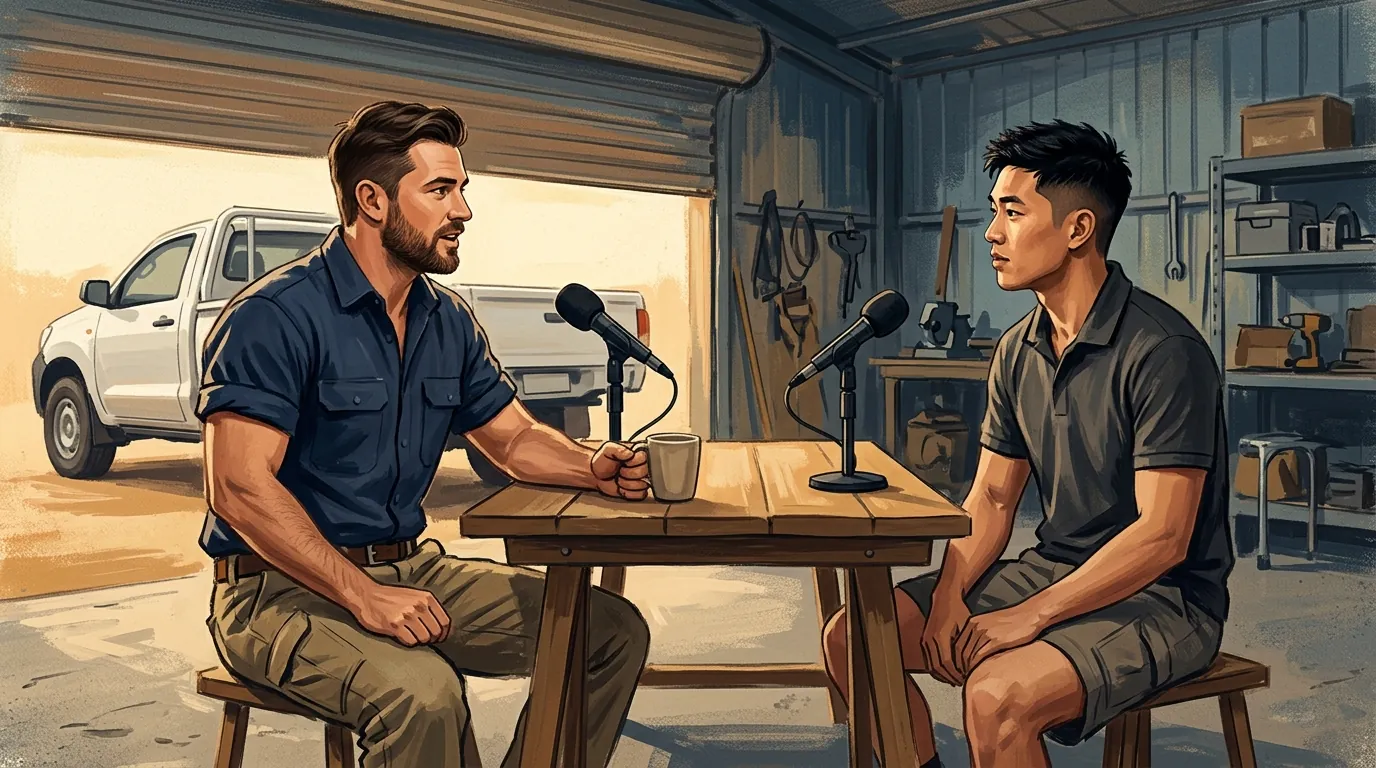
Chris Killus started Saints Electrical in August 2022 as a sole trader. By September, he'd joined Tradies Success Academy. Within months, he made his first hire — and got it wrong.
"My first hire was an apprentice," Chris says. "It was probably the wrong move. He's still with us and he's terrific, but I should have hired a tradesman first."
The problem wasn't the person. It was the timing. When you're a solo trader wearing every hat, bringing on someone who needs training and development consumes the one resource you don't have: your attention. You get trapped on the hamster wheel, doing the work instead of growing the business.
The moment Chris hired his first tradesman? Everything changed.
The cost of a bad hire is immediate. The return on a good hire is generational. Chris learned this the hard way — then systematised it.
Tradies Success Academy gives you the frameworks, systems, and coaching to build a business that works without you.
When you're doing all the work, you can't do any of it well. You're on site, so you can't call leads. You're on the phone, so you can't install. You're at the job, so you can't manage the business.
"It meant that I didn't have to be there for absolutely everything. I was able to remove myself from site and concentrate on bigger picture activities."
After getting the first hire wrong, Chris developed a repeatable system. Here's how he built Saints Electrical from a one-man band into a performing team.
Bring on an experienced tradesman before support staff. You need to free yourself from site before you can hire for admin.
Start with part-time or remote support (VA). Test the workload, the hours, the tasks. Understand what the role really needs.
Move to a full-time admin manager during business hours. Someone who can take feedback, grow, and own the role.
Your full-time admin trains and supports part-time team members. You build a mentorship chain instead of a dependency chain.
Find the right program for your trade and your stage of growth.
By late 2024, Chris had a tradesman and was winning more work. But admin was eating him alive. Emails, scheduling, customer follow-ups, invoicing. He needed help.
"She was terrific and quick to learn, but she was working full-time elsewhere. She could only log on from 6:30pm — the exact time I'm in dad mode, doing showers and putting kids to bed. I didn't have bandwidth to train her."
Phase 2: Renegotiate + Hire Full-Time Admin
"We increased her hours but with a condition: available during business hours. At the same time, we hired our first full-time admin manager. Laura. She's been an absolute godsend."
"Laura took our VA under her wing and provided guidance and support that I simply didn't have bandwidth to do. Having the right people with the right level of expertise has been a game-changer."
Now his team is scaling: Ty (tradesman), Adrian (apprentice), Laura (admin manager), Fairy (VA). The business runs without Chris on every job. That's the system.
Chris didn't just stumble into hiring. He stumbled into the future. Saints Electrical specialises in EV charger installation — one of the fastest-growing sectors in the trade industry.
Electric vehicles aren't coming. They're here. Governments are phasing out petrol cars. Every EV owner needs a home charger. Demand is accelerating.
EV charger installation requires running a dedicated circuit from the switchboard, assessing load capacity, and managing the customer experience across site prep to post-sale support.
Most electricians haven't built systems around this work. Chris has. He can scale faster, deliver better, and build a team around repeatable processes.
If you hire reactively, you get a disaster. If you hire intentionally, you get ROI. Here's Chris's process:
Post the role. Get applications. Don't hire someone you met at the supermarket because you're busy.
Interview for attitude, learning speed, and commitment to your vision. Skills can be taught. Attitude can't.
Be crystal clear about what you need, when, and how. Chris onboards new tradesmen by explaining the customer experience first: "Here's how we treat people. Here's how we run jobs. Here's what we deliver."
Build a playbook so that training is repeatable. By month 6-8, a good hire should be delivering and costing you nothing extra.
Is this person freeing your time? Are they increasing output? Are they taking the pressure off? If yes, promote them or expand their role. If no, address it fast.
Once you have a senior person (like Laura), they become your training hub. New people learn from them, not from you. That's when you truly scale.
Whether you're in electrical, plumbing, carpentry, or HVAC, the hiring framework is the same. You're not building a bigger solo business. You're building a business that doesn't need you on every job.
Hire a qualified tradesman first. Get off every job so you can grow the business.
Document how jobs are run, how customers are treated, what quality looks like. Make it repeatable.
Most traders only hire other tradespeople. Admin is where you unlock exponential growth.
Let your senior people train and develop junior people. You become a business owner, not a trainer.
Chris isn't alone in this journey. Hundreds of traders have built similar hiring systems through Tradies Success Academy. Josh Graham, Levi Hamilton, and Jack May coach on hiring every single day. They teach the exact framework Chris discovered on his own — so you don't have to.
"I joined the Academy in September 2022. I haven't looked back. The cost pays for itself in the first month. Just do it. It's the best thing you will ever do for your business."
The Academy isn't about tips. It's about frameworks. It's about getting honest feedback from people who've already scaled trades like yours. It's about not repeating mistakes that cost years and tens of thousands of dollars.
"Get involved in the community. You get out what you put in. Being in business can be incredibly lonely. Having a community of business owners in similar positions gives you leverage. We're all in it together."
Chris also wanted to acknowledge his wife Stephanie, who supported the business journey even though she's not in it. And his team: Ty, Adrian, Laura, and Fairy — "You guys are rock stars. Keep it up."
The proof is in the system. In 20 months, Chris scaled from solo trader to leading a team. He's not working harder. He's working smarter. And he's training others to do the same.
The hiring fundamentals every trade owner needs to know before bringing on their first team member.
What to do when the market is tight and good people are hard to find. Systems for making it work anyway.
How one tradie restructured his business to be there for his family. The hiring and systems that made it possible.
This episode applies differently depending on your business stage. Here is the specific action for each phase.
Get weekly financial visibility in place before anything else. 30 minutes every Friday: what came in, what went out, what is your margin. Build the habit first, then layer systems on top. Start in the Learning Hub .
Your first hire for freedom is a qualified tradesperson, not an apprentice. Cost every job before you quote. Track hours against every job. Follow the scaling loop — proactive hiring, never reactive.
Delegate the weekly numbers review to your operations manager. Your job is now strategy and work generation. Systemise the Financial Visibility Loop so it runs without you.
Dashboards, not spreadsheets. Margins tracked per job, per team, per division. Hire decisions backed by data. You are optimising a machine, not building one. If you are still firefighting, the system is broken.
This episode applies differently depending on your business stage. Here is the specific action for each phase.
Get weekly financial visibility in place before anything else. 30 minutes every Friday: what came in, what went out, what is your margin. Build the habit first, then layer systems on top. Start in the Learning Hub.
Your first hire for freedom is a qualified tradesperson, not an apprentice. Cost every job before you quote. Track hours against every job. Follow the scaling loop — proactive hiring, never reactive.
Delegate the weekly numbers review to your operations manager. Your job is now strategy and work generation. Systemise the Financial Visibility Loop so it runs without you.
Dashboards, not spreadsheets. Margins tracked per job, per team, per division. Hire decisions backed by data. You are optimising a machine, not building one. If you are still firefighting, the system is broken.
The frameworks in this episode are the same ones members use inside Tradies Success Academy.