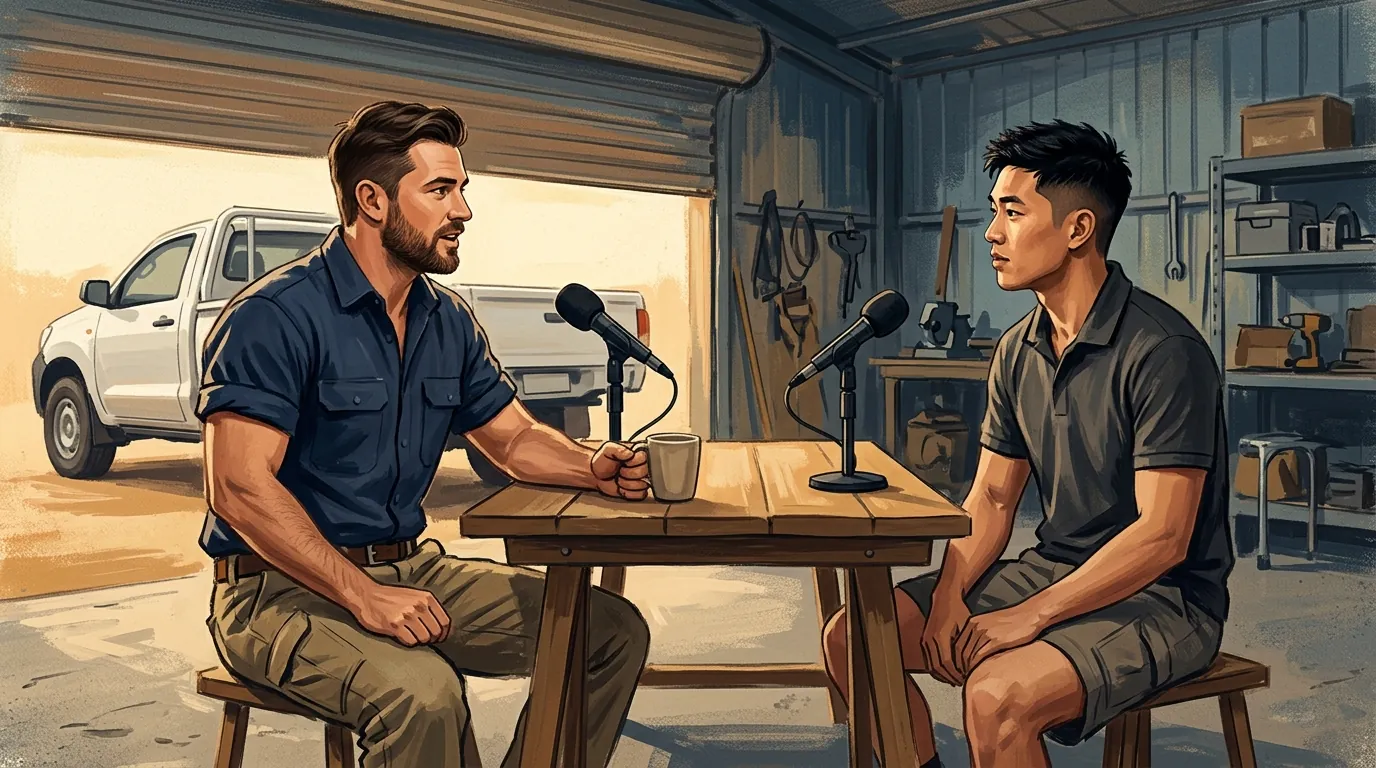
Subscribe to the Tradies Success Podcast on your favourite platform.
James Stanner Street is a biologist and certified agroforester who built Australian Agro Forestry Solutions from a single apprenticeship into a systemised operation managing 300+ acres across diverse client properties. But his real expertise is something far larger: understanding how every trade ecosystem works together.
When James started as a financial advisor, he realised the critical gap: he wasn't solving real problems for people. He pivoted completely. A Bachelor of Science in biology led to a three-year apprenticeship with Dr Glen Cross, and then to founding his own agroforestry practice. The transition from expert solo practitioner to building a team that could scale brought him face-to-face with the exact challenges every trade business owner faces.
This episode breaks down the four-phase client pipeline (discovery, design, implementation, management), reveals why assuming your team knows what you know is the fastest way to lose money and reputation, and explores how treating your business—and your entire trade ecosystem—as a living system rather than a collection of tasks changes everything.
A 300-acre regenerative forest project isn't just trees. It involves builders, excavators, plumbers, landscapers, and more. Understanding the interdependence of trades is how you deliver real value.
Viewing your work as part of a larger ecosystem—not isolated tasks—reveals where critical phases are and what can wait. This is what separates expert practitioners from those just grinding.
Projects can span 3–5 years. That continuity builds trust. Your client knows you're invested in the outcome, not just the next invoice. That's how specialists command premium pricing.
Clients hire you because they don't know what you know. Recommending the right solution (not just what they ask for) is your job. Most trades forget this and drop their value to zero.
Tradies Success Academy gives you the frameworks, systems, and coaching to build a business that works without you.
Agroforestry isn't new in principle—it's just forestry with intentional production layers. Food, fuel, fibre, medicine. You're growing trees, but you're also solving real problems: soil health, water retention, habitat creation, carbon sequestration.
The reason every trade should care: most trades work in isolation. Electricians run power, plumbers run water, builders put up structures. But an agroforestry project requires all of them working in sequence on a landscape-wide scale. It's a masterclass in coordinated execution.
The bigger lesson is about understanding your trade's role in the larger ecosystem. James works alongside builders creating homesteads, excavators clearing land, landscapers designing zones. If you don't understand how your work feeds into the next trade's work, you're creating friction instead of flow.
At a wedding, surrounded by people who loved their work (his sister the winemaker, others in fields they were passionate about), James had a moment of clarity: he didn't love what he was doing. That question—"Do I love this?"—is worth asking regularly.
He pivoted to a Bachelor of Science in biology because science was answering real problems: sustainability, feeding people, building local systems. Then came a three-year apprenticeship with Dr Glen Cross, who was actually building forests. Real, hands-on learning from someone doing the work at a high level.
This transition reveals something most trades miss: the gap between formal qualifications and real competence. James had credentials after the apprenticeship, but what he really gained was the ability to assess a property, understand its specific challenges, and make decisions based on that landscape. That's what clients pay for.
James breaks his process into four clear phases: discovery, design, implementation, and management. This is systems thinking in action.
James views his projects, his team, and the entire trade network as interconnected systems. When one part fails, the whole thing slows. When everyone understands boundaries and supports each other, everything accelerates.
James doesn't skip his karate and meditation practice, even when work is chaotic. This isn't wellness theatre—it's the foundation that lets him show up as his best self at work, with his family, and with his team.
Leads you don't chase because systems are broken. Opportunities you don't see because you're firefighting. Relationships that suffer because you're not present. These compound faster than revenue grows.
A team member with the right credentials isn't automatically at the standard you need. Show them once, watch them, then step back. That's the onboarding that builds a high-performance team.
The trades culture of figuring it out alone is expensive. James's regret: not getting a business coach on day one. Collective knowledge compounds. Shared frameworks save years of painful learning.
Find the right program for your trade and your stage of growth.
This episode is essential for all phases. Foundation: understand that specialist expertise is your moat. Growth: learn the systems James built to scale from solo to team. Expansion: apply ecosystem thinking to your growing contractor network. Scale: watch how James structures long-term client relationships and delegation.
This episode applies differently depending on your business stage. Here is the specific action for each phase.
Get weekly financial visibility in place before anything else. 30 minutes every Friday: what came in, what went out, what is your margin. Build the habit first, then layer systems on top. Start in the Learning Hub .
Your first hire for freedom is a qualified tradesperson, not an apprentice. Cost every job before you quote. Track hours against every job. Follow the scaling loop — proactive hiring, never reactive.
Delegate the weekly numbers review to your operations manager. Your job is now strategy and work generation. Systemise the Financial Visibility Loop so it runs without you.
Dashboards, not spreadsheets. Margins tracked per job, per team, per division. Hire decisions backed by data. You are optimising a machine, not building one. If you are still firefighting, the system is broken.
This episode applies differently depending on your business stage. Here is the specific action for each phase.
Get weekly financial visibility in place before anything else. 30 minutes every Friday: what came in, what went out, what is your margin. Build the habit first, then layer systems on top. Start in the Learning Hub.
Your first hire for freedom is a qualified tradesperson, not an apprentice. Cost every job before you quote. Track hours against every job. Follow the scaling loop — proactive hiring, never reactive.
Delegate the weekly numbers review to your operations manager. Your job is now strategy and work generation. Systemise the Financial Visibility Loop so it runs without you.
Dashboards, not spreadsheets. Margins tracked per job, per team, per division. Hire decisions backed by data. You are optimising a machine, not building one. If you are still firefighting, the system is broken.
The frameworks in this episode are the same ones members use inside Tradies Success Academy.