Articles

How do you write job notes that get the invoice right first time?

Job notes get the invoice right first time when they capture the job the moment it happens, not from memory at the end of the day. That means materials used, time on site, variations agreed, and photos, all logged before the ute leaves. The Agent Office uses an AI agent to prompt for that information on site and turn it straight into invoice wording, so nothing gets guessed or left out.

The Academy is at full capacity. 9,000+ owners trained, 4.9 stars from 123 Google reviews.

Why do invoices come out wrong even when the job notes seem fine?

Most invoice disputes do not start at invoicing. They start on site, hours earlier, when something gets done but not written down. A trade business can have a perfectly good invoice template and still send out the wrong number, because the gap sits in the notes, not the paperwork.

The pattern is familiar. The crew finishes a job, moves straight to the next one, and the details get written up later from memory. A variation gets agreed verbally on site but never makes it onto paper. Extra materials go in the van but not in the notes. By the time someone sits down to invoice, hours or even a day has passed, and the details have gone soft.

What usually goes missing between the site and the office?

The things that usually go missing are the things that cost money. Extra time, extra materials, and agreed variations rarely make it into a scribbled note, because nobody wants to stop mid job to write a paragraph. The crew is focused on the work, not the admin.

So the invoice gets built later from whatever is remembered, which is often less than what actually happened. The business either undercharges and eats the cost, or sends an invoice the customer disputes because it does not match what they recall agreeing to on site. Either way, the owner ends up chasing the gap after the job is done, which is the most expensive time to chase anything.

What should job notes actually capture to make the invoice right?

Job notes need four things captured at the time, not after: materials used, time on site, any variation agreed with the customer, and a photo where it matters. If those four things exist for every job, the invoice almost writes itself, because there is nothing left to guess or recall.

The trick is making this quick enough that the crew will actually do it. A long form nobody fills in is worse than no form. The notes need to be fast to log, worded the way the business already talks to customers, and tied directly to what ends up on the invoice, not a separate exercise that happens twice.

How can an AI agent make sure the invoice matches the job every time?

An AI agent is software that does a job the way the owner would, using the owner's prices, wording and rules, without someone having to sit at a desk and do it manually. For job notes, an agent can prompt the crew on site for exactly what is needed, in plain language, before the job is marked complete.

Picture a plumber who finishes a callout and gets asked by the agent, right there on the phone, what parts were used, how long it took, and whether anything changed from the quote. The answers go straight into the business's own pricing and wording, so the invoice that comes out the other end already matches what happened on site. Nothing waits for someone to remember it that evening.

Where does the Agent Office fit into fixing job notes for good?

The Agent Office puts an AI agent at the exact point where the problem usually starts, which is the moment a job finishes and before the invoice gets written. That is the method worth remembering: find where the gap opens up, and place the agent just before it, so the job cannot move on until the right information is there.

This takes a job off the owner's night, not off the crew's day. The crew still does the work. The agent makes sure what they did gets captured properly, in the business's own words and prices, so the invoice that goes out matches the job without anyone having to chase it up later.

Also asked

More questions owners ask.

Do job notes need to be detailed for every single job, even small ones?

Small jobs still need the basics logged, materials, time, and any variation, because small gaps add up across a lot of small jobs. An agent prompting for this on every job, large or small, keeps it consistent without adding admin for the crew.

What if the crew forgets to log something while on site?

An agent can be set to ask before the job is marked finished, so it cannot be skipped by accident. This moves the check to the point of the work, rather than relying on someone remembering to go back and fill it in.

Can an AI agent write the invoice in the business's own wording, not generic text?

Yes, an agent is set up with the business's own prices, phrasing and rules, so the invoice it produces reads the way the owner would write it, not a generic template.

Does this replace the need for a job management system?

No, an AI agent usually works alongside whatever system the business already uses for scheduling, quoting and invoicing. It handles the capture and prompting at the point the information is created, feeding clean details into the existing system.

Why Greg

You speak to the owner who has already done it.

Greg built Response Electricians in Perth into a 30+ staff business with 1,950+ five-star reviews. A general manager runs it.

He has trained 9,000+ trade business owners across Australia and New Zealand.

He grew a coaching company to 35 staff, a CEO and 15 coaches, then cut it back so every owner deals with him directly.

Most coaching companies hand you to a salesperson, then to a coach who has never run a trade business. Here you get the owner.

The Academy is at full capacity. Greg is the only coach, so he only takes on owners who are building for the right reasons and give back to the group. Join the waitlist and he will be in touch when a place opens.

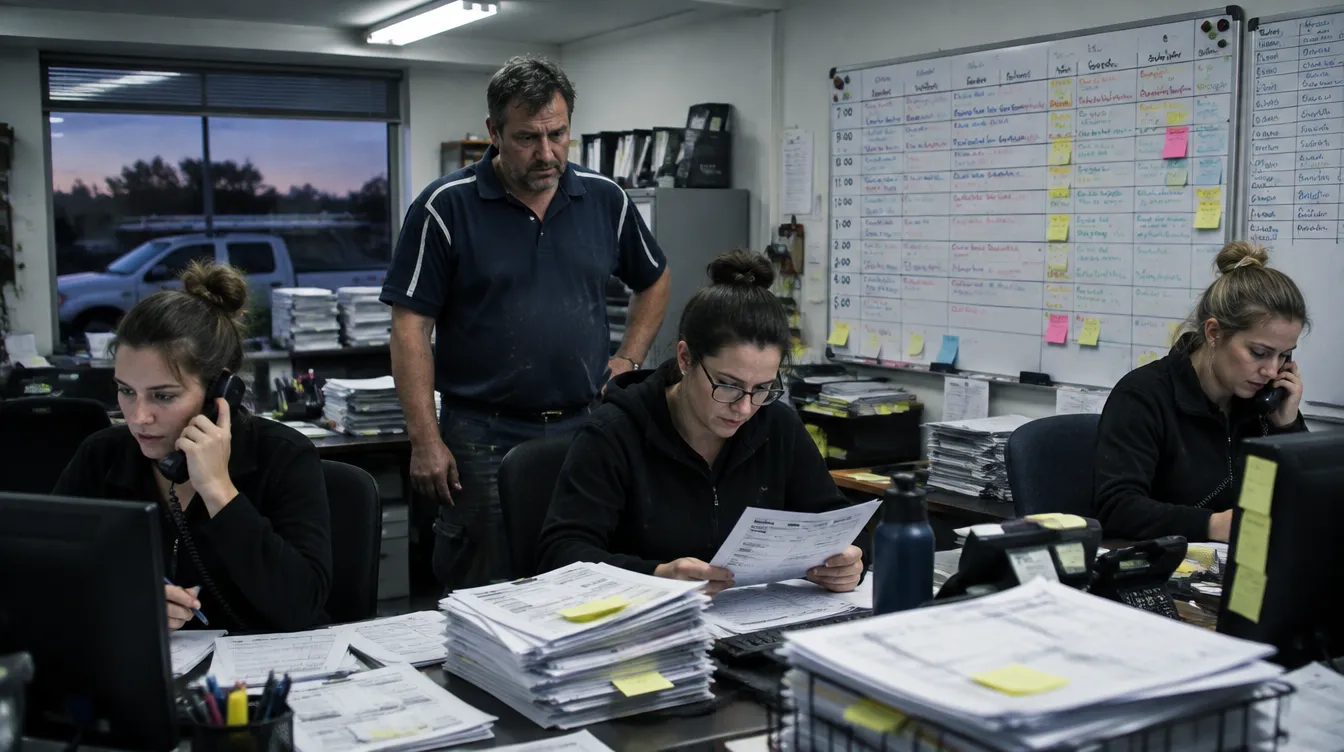
Illustration: a trade business owner standing over three office staff buried in paperwork at night.
The old way

More customers meant more people doing the computer work, and more wages nobody invoices.

Illustration: a tradesman shaking hands with a homeowner in her driveway, his phone showing jobs quoted and invoiced.
The new way

You stay with your customers and your team. Agents run the office your way.

The old way

More jobs. More paperwork. Less of the owner left.

Most trade businesses grow the same way.

More jobs means more quoting, invoicing, chasing and scheduling.

None of it gets paid for.

So the owner does it at night, after a full day on site.

Or hires an office person to do it.

The office grows. The wages grow. The margin does not.

And the owner is still the one everything waits on.

The new way

Meet the Agent Office.

An agent is software that does a job the way you would do it.

Your prices. Your wording. Your rules.

It writes the quote while you are still on site.

It sends the invoice the moment the job is done, and chases it until it is paid.

No sick days. No capacity limit. No extra wage.

Your people stay on what people do best: your customers and your crew.

You only add people who face customers and lead the crew. Everything else, the Agent Office handles.

P.S.

P.S. Joining the waitlist costs nothing and there is no obligation. While you wait, the Tradies App is free with an active ABN, so you can start on the lessons tonight.