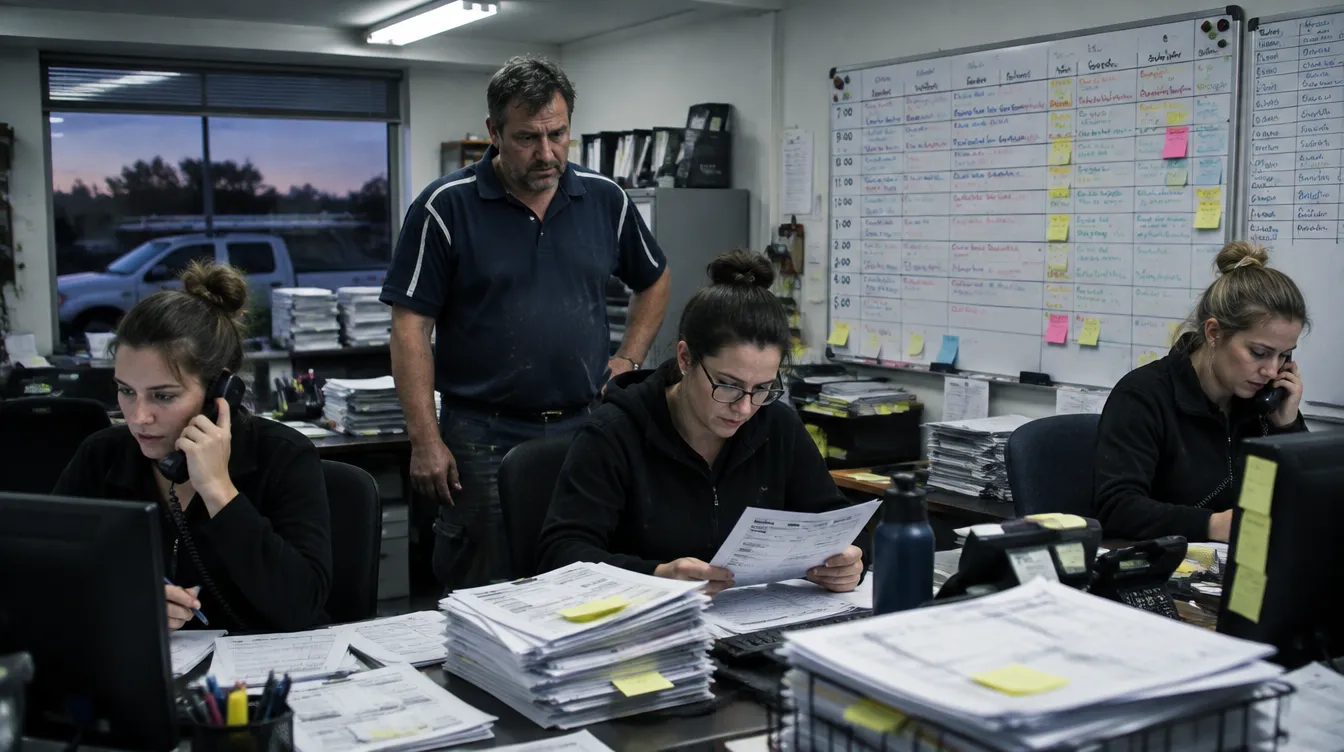
Why does the phone never stop ringing for a trade business owner?
Most trade business owners answer the phone because nobody else can. The prices live in their head, the scheduling lives in their head, and the customer wants an answer now, not a callback. So the phone rings on the tools, in the van, at dinner, and the owner answers it every single time because the alternative is losing the job.
A job comes in. The owner stops what they are doing, works out a rough price on the fly, checks the diary in their head, and promises to call back with details. That promise becomes another phone call later. Multiply that by every enquiry in a week and the owner has built themselves a second job that pays nothing extra.
What does answering every call actually cost a tradie?
It costs the owner the thing they are actually paid for, which is the work in front of them. Every interruption breaks concentration on the tools, slows the crew down, and pushes quoting and invoicing into the evening. The business can grow, but the owner's day does not get any shorter.
There is also a quieter cost. Calls that come in after hours, on weekends, or while the owner is mid job often just ring out. The caller moves to the next name on the list. The owner never finds out the job existed, so it never shows up as a lost sale, it just never happened.
How do you stop being the one who has to pick up?
You stop being the receptionist by putting something in front of the phone that can answer the way you would, every time, without needing you awake or available. This is where an AI agent comes in. An agent is software that does a job the way you would do it, using your prices, your wording and your rules, at any hour, without another wage going out.
You are not hiring someone to read a script. You are setting up an agent that answers an enquiry, asks the questions you would ask, gives a price using your actual rate card, and books the job straight into your diary if it fits the rules you have set. If it does not fit, it flags the call for you instead of guessing.
What is an AI agent and how does it answer calls the way you would?
An AI agent in the Agent Office is built around your rules, not generic scripts. You tell it your call-out fee, your minimum job size, which postcodes you cover, and which jobs always need you on the phone personally. From there it handles the enquiry the way you would, in your tone, with your numbers.
Picture a plumber who gets call after call for blocked drains, hot water units and quotes on new bathrooms. An agent set up with his pricing and his rules can answer the blocked drain and hot water calls on the spot, book them straight into the diary, and only pass the bathroom renovation enquiry through to him because that one needs a measure and a proper quote. He is not fielding every call anymore, only the ones that actually need him.
Where should the agent sit so nothing gets missed?
The agent needs to sit right where the phone call starts, before anyone promises a price or a time slot without the full picture. That is the point where jobs usually go wrong, someone quotes from memory, forgets to ask a key question, or books a slot that clashes with another job.
Put the agent there and the call cannot move forward until the right information is captured. Address, job type, timing, access, all gathered the same way every time, before anything gets booked or promised. The owner is not chasing missing details later because the agent never let the gap happen in the first place.
What happens to the calls you actually want to take?
They still come to you, just fewer of them and at a better time. The Agent Office is not about removing you from the phone completely, it is about removing you from the calls that do not need your judgement. The big jobs, the awkward customers, the ones that need your experience, those still land on your desk.
You end up picking up the phone because you chose to, not because it rang and nobody else could answer it. The crew keeps working, the quotes keep going out, and the diary keeps filling, all without you being chained to the handset.