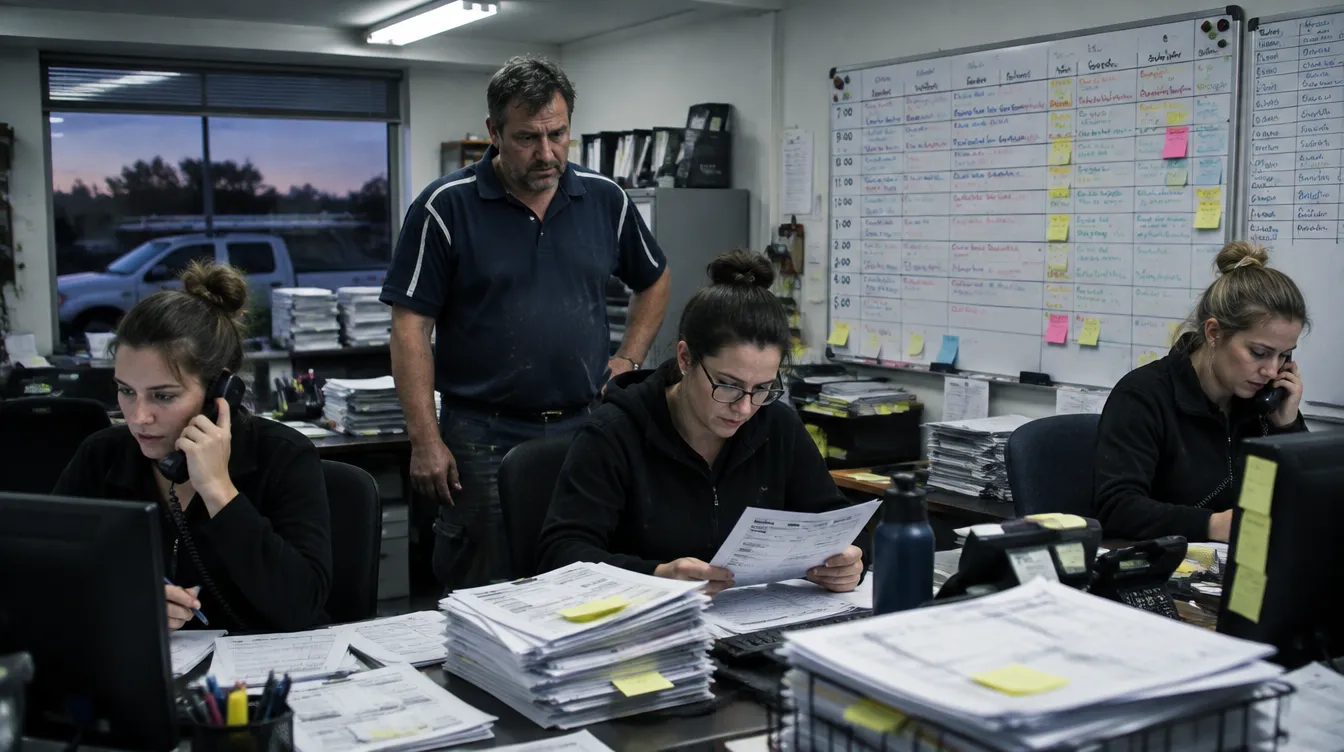
Why does quoting take so long for most trade business owners?
Quoting takes long because the owner is usually the one chasing missing information before they can even start the numbers. Photos arrive late, measurements are vague, and the enquiry sits in a text thread with half the job description missing. The owner ends up calling the customer back just to ask what should have been in the first message.
Most trade businesses do not have a quoting problem. They have an information problem. The quote itself might take ten minutes to write once everything needed is sitting in front of the owner. The hour disappears before that, hunting for the gaps.
A trade business with a steady flow of enquiries can lose a surprising amount of a week this way. Not because the owner is slow, but because the job cannot move until someone tracks down what is missing, and that someone is almost always the owner.
Why does quoting always end up happening at night?
Quoting happens at night because it is the task that gets bumped every time something more urgent shows up during the day. A burst pipe, a late delivery, a crew question, any of these push quoting to the bottom of the pile. By the time the owner sits down to it, the kids are in bed and the day is meant to be over.
The owner is on the tools from early morning, then becomes the quoting department once the ute is parked. Nothing about that second shift gets paid for. The business still grows, the enquiries still come in, but the margin does not move because the extra hours are free.
This is the pattern behind most late quotes. It is not that the owner cannot write a quote. It is that the quote has to compete with everything else that happened that day, and it usually loses.
How do you quote faster without just rushing it?
You quote faster by moving the information gathering to before the quote starts, so there is nothing left to chase when you sit down to write it. This is where an AI agent fits. An agent is software that does a job your way, using your prices, your wording and your rules, and it works at any hour without needing a wage.
Picture a plumber who gets an enquiry through a contact form at nine at night. Instead of that message sitting untouched until morning, an agent asks the follow-up questions straight away: what the job is, where it is, what photos are needed, what the customer's timeframe looks like. By the time the plumber opens the laptop, the job is ready to quote, not half described.
That is the method. Find where the problem starts, which is the missing information, and put the agent right there, before the quote is attempted. The job cannot move forward until the right details are in, so the owner stops writing quotes around guesswork.
What does an AI agent actually do during quoting?
An agent in the Agent Office handles the repetitive parts of quoting that do not need the owner's judgement: collecting job details, applying the right pricing structure, and drafting the quote in the business's own wording. The owner still checks it and sends it, but the blank page and the back and forth are gone.
This is different to generic quoting software that just gives you a template. The agent is set up with your prices, your margins, your way of describing the work, so what comes out the other end sounds like you wrote it. It can also flag anything unusual, like a job that does not match the standard scope, so the owner's attention goes where it is actually needed.
The point is not to remove the owner from quoting. It is to remove the parts of quoting that were never a good use of the owner's time in the first place, so what is left takes minutes instead of an evening.
How do you make sure the quote still sounds like you, not a robot?
You keep control of the wording and the pricing by training the agent on how you already quote, not by handing it a generic script. An agent built for your business uses your rates, your line items, your terms, and your tone, because that is what it was set up with.
The owner stays the one who decides what the business charges and how a quote is worded. The agent just removes the hours spent typing it out and chasing the details that should have come in with the enquiry. Customers get a quote that reads the same as it always did, it just arrives a lot sooner.
Over time, as more enquiries run through the same pattern, the agent gets quicker at pulling together a clean, accurate draft, because it is working from the same set of rules every time rather than the owner starting fresh each night.